Purpose of FlexNet Publisher Enterprise
The primary purpose of FlexNet Publisher Enterprise is to enhance the performance of a FlexNet Publisher license server by increasing the number of simultaneous client connections it can support and improving the license checkout rate.
The FlexNet Publisher Enterprise functionality allows organizations to efficiently scale their Electronic Design Automation (EDA) and High Performance Computing (HPC) environments by distributing license requests across multiple vendor daemons. This optimizes the computational resources to enhance performance and reliability, and reduces operational costs. The following outlines the primary objectives of FlexNet Publisher Enterprise:
| • | Increases the number of simultaneous client connections—FlexNet Publisher Enterprise enhances the performance of FlexNet Publisher license server by increasing the number of simultaneous client connections it can support. |
| • | Distributes clients across multiple publisher vendor daemons—This capacity enhancement to FlexNet Publisher license servers is achieved by distributing clients across multiple vendor daemons (VDs) for a publisher instead of focusing on a single vendor daemon, ensuring a balanced load distribution. All client requests are distributed in a controlled manner, with new clients being directed to the least loaded vendor daemon. |
| • | Optimizes resource utilization and streamlines upgrades—FlexNet Publisher Enterprise utilizes system resources of single machine effectively, streamlining the upgrade process and emphasizing capacity enhancements for FlexNet Publisher license servers. |
| • | Capacity: Increases client connection counts —An internal testing result has shown that an installation with 16 vendor daemons can boost client connection counts. |
Note:The client connection counts may vary depending on the system.
To obtain access to the FlexNet Publisher Enterprise—in order to support advanced licensing capabilities—please contact your product vendor.
Scaling License Servers to Meet Growing Demand
By consolidating license server infrastructure and enhancing the computational efficiency, FlexNet Publisher Enterprise optimizes license distribution to efficiently handle higher client loads.
As chip production for artificial intelligence (AI) and machine learning (ML) accelerates, FlexNet Publisher Enterprise offers significant value to the semiconductor industry by enabling high-performance license management that scales to meet the increasing demands.
For industries dependent on advanced simulation, automation, animation, and engineering, FlexNet Publisher Enterprise delivers the robust and scalable infrastructure required to support growing workloads while ensuring service continuity.
Example Scenario Benefiting from FlexNet Publisher Enterprise
The driver for the FlexNet Publisher Enterprise add-on to FlexNet Publisher is to meet the growing demands of semiconductor and other software vendors engaged in high performance computing. There is a significant capacity scaling challenge driven by the demands of AI and ML chip advancements.
The following is a typical FlexNet Publisher license server deployment scheme in an end customer enterprise:
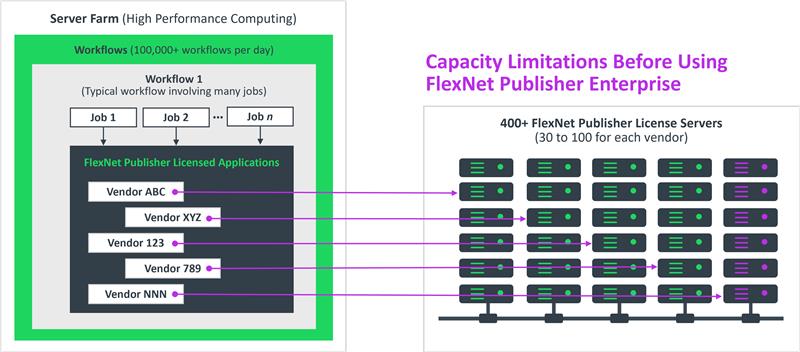
License Server Capacity Limitations Before Using FlexNet Publisher Enterprise
| • | Testing workflows require thousands of simultaneous license checkouts—These types of testing requirements need to perform extensive testing using server farms on the chips that they manufacture, requiring many different testing applications to be launched repeatedly (using automated workflows that kick off thousands of jobs) to test chips. This has caused a bottleneck in license checkouts on standard FlexNet Publisher license servers. Current FlexNet Publisher license server capacity limits are being reached. You currently cannot go beyond 65K connections on Windows machines or 120K connections on Linux machines. |
| • | Server capacity limits result in the requirement for additional license servers—In scenarios where capacity needs are beyond these numbers, license administrators have to spin up additional license servers and split the license counts |
| • | Additional license servers are expensive—Certain busy deployments typically have 200 to 400 license servers, which have a high operational cost (costing over hundreds of thousands of dollars per year) and have multiple points of failure. For each FlexNet Publisher-licensed software application in use, the customer might need 40-70 license servers to meet their demands. |
| • | Without FlexNet Publisher Enterprise, FlexNet Publisher license servers cannot leverage multi-core or multiple virtual processors—The biggest problem encountered with the existing FlexNet Publisher license servers was that it was multi-threaded, so no matter what type of powerful computer you used, because it is not leveraging multi-core or multiple virtual processors in a virtualized environment, it is not able to give you a capacity beyond a certain upper limit. |
How FlexNet Publisher Enterprise Increases License Checkout Capacity
FlexNet Publisher Enterprise is able to create many incarnations of vendor daemons in different process IDs. By doing that, it is able to leverage the power of multi-core processors and when the requests come to an lmgrd license server, the load balancer will distribute license loads across multiple vendor daemons, increasing the capacity by 8 to 12 times. All load balancing is performed within a single machine.
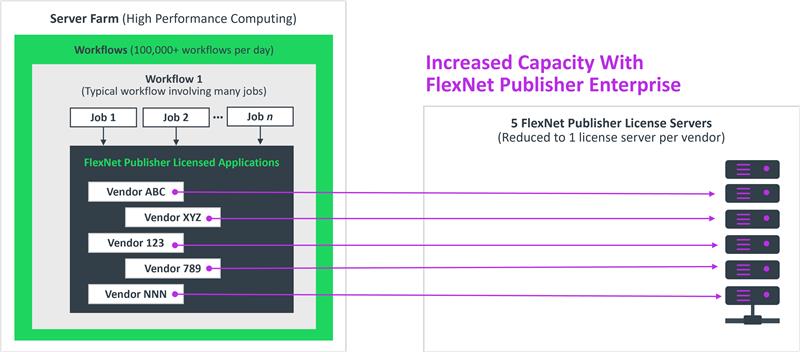
Increased License Server Capacity With FlexNet Publisher Enterprise
When using FlexNet Publisher Enterprise, a customer that previously required 200 to 400 license servers would then need only 30 to 40. If the customer previously used 30 to 40 license servers, they might then only need one. This will greatly simplify required IT infrastructure.