License Server Usage and Denials Report
The License Server Usage and Denials report provides insights into the usage of licenses on Cloud License Server (CLS) instances and local license servers.
Important:Pushing usage data from a local license server to the Data Warehouse requires certain configurations to be set, see Making Local License Usage Data Available in the Data Warehouse.
The report shows how many licenses are being used, how many are available, and the most active accounts, as well as information about denied license requests. By providing detailed insights into how licenses are used, organizations can optimize their license purchases, ensure compliance, plan for future needs, and make informed strategic decisions.
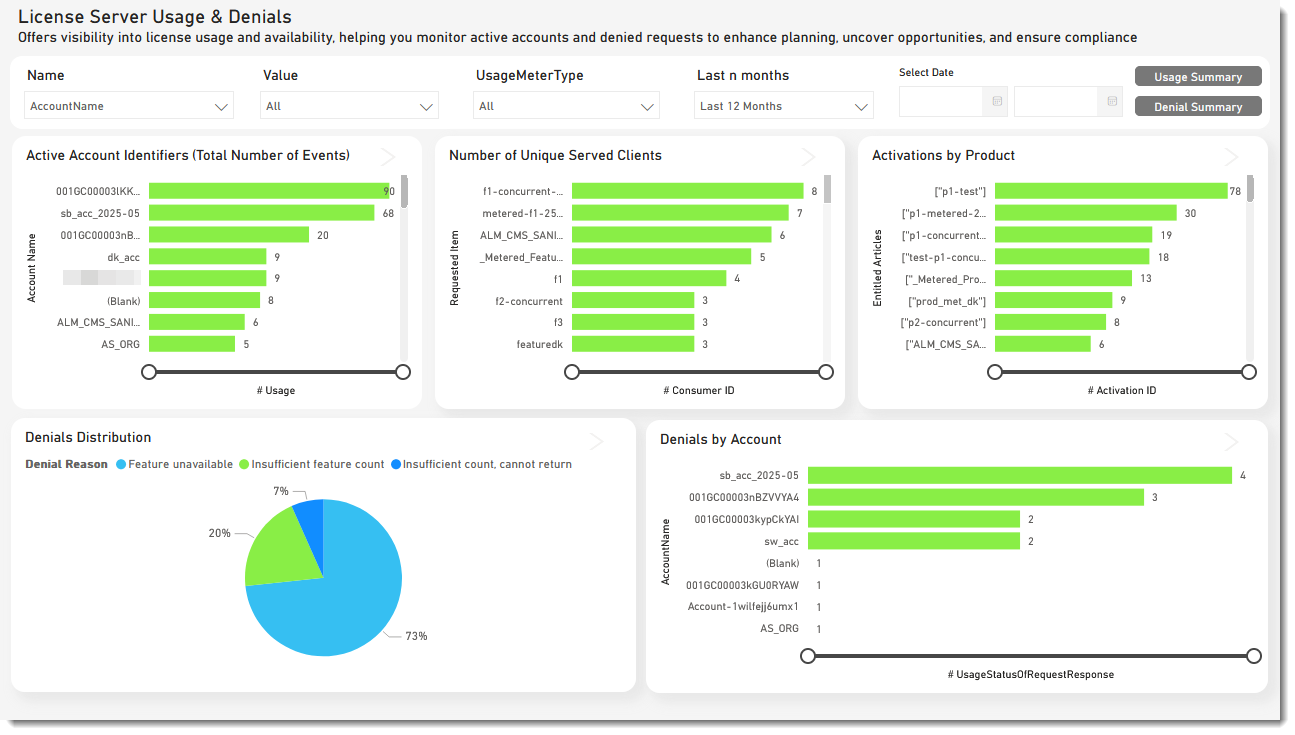
Example of the License Server Usage & Denials report.
Main Entities in the License Server Usage and Denials Report
The following diagram shows the most relevant entities—publisher, CLS instance, end user and devices—for the License Server Usage and Denials report.
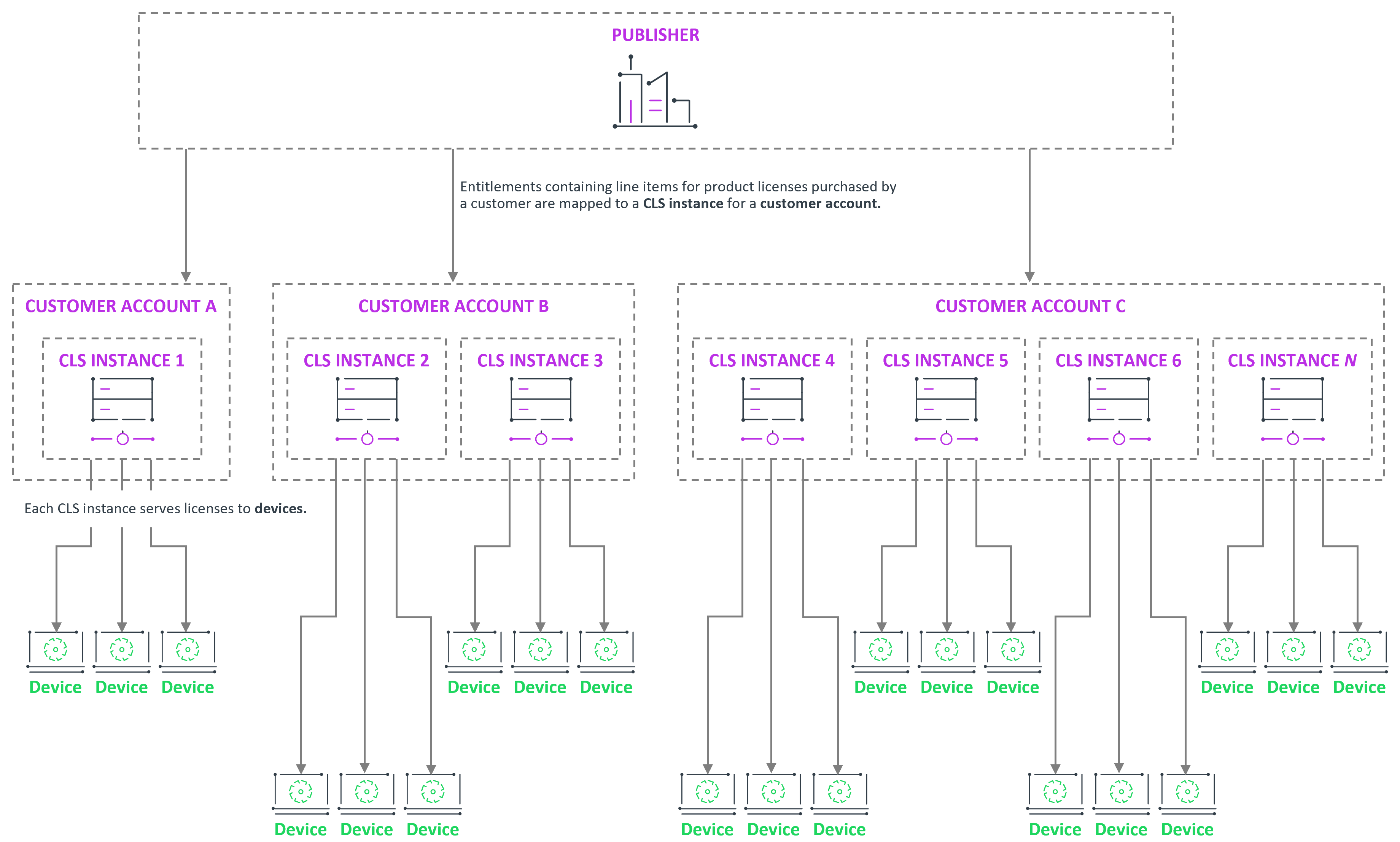
Main entities in the License Server Usage and Denials report
Making Local License Usage Data Available in the Data Warehouse
For usage data from a local license server to be available in the Data Warehouse, the following policy settings must be configured:
| • | usageService.sync.enabled—Must be set to true. |
| • | usageService.sync.url—Must point to the usage service URL, which is |
https://<siteId>.compliance.flexnetoperations.com/usage/api/1.0/sync
where <siteId> is replaced with the specific site ID supplied by Revenera, for example:
https://flex1234.compliance.flexnetoperations.com/usage/api/1.0/sync
| • | licensing.trackDeniedRequests—Must be set to true if the usage data should also include denied request information. To disable tracking of denied requests, licensing.trackDeniedRequests must be set to false. |
For more information, see the topic “Pushing Usage Data to the Data Warehouse” in the FlexNet Embedded License Server Producer Guide (available from the Product and License Center).
Description of License Types
| • | Concurrent—A concurrent licensing model limits the maximum number of clients using the software at the same time. Users get a defined number of licenses to be used at the same time and on any device. If all the licenses are in use, an employee must wait for a concurrent license to become available before being granted access. |
| • | Metered—In a metered licensing model, users are charged for the actual use of the software. Usage can either be capped (usage cannot exceed a predefined limit) or uncapped with pay-for-overage (usage is tracked and reported, but there are no limits to usage; consumption above the pre-defined limit is allowed and customers are charged for the overage). |